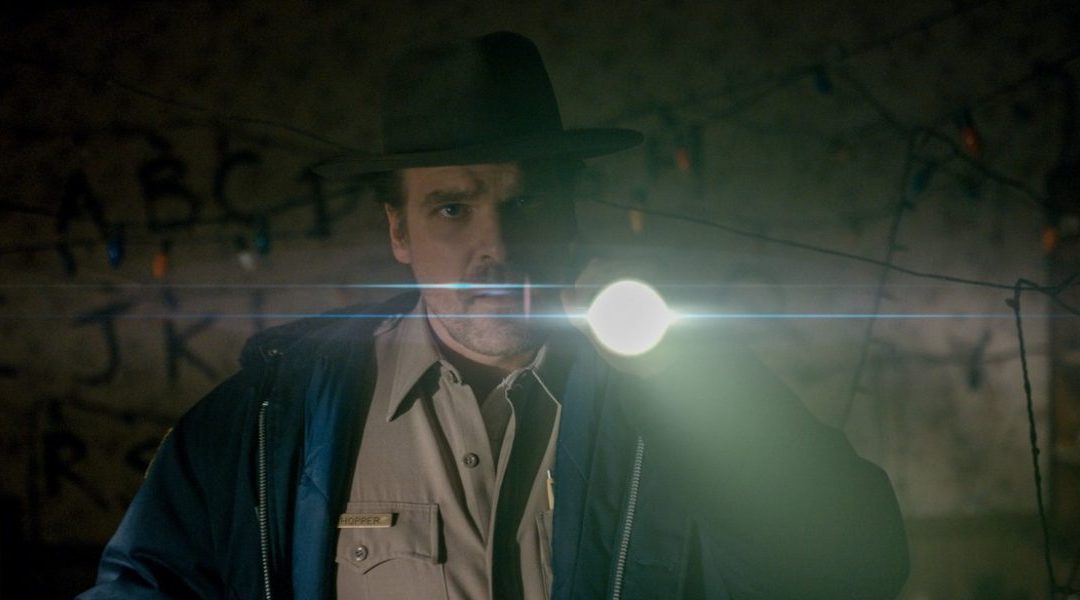
With a title like Stranger Things, one might expect a world that’s intense, mysterious and dark. And one would be exactly right. However, dark isn’t always metaphorical; the Netflix series often takes literal forays into the dead of night, darkened rooms, and ink black tunnels. When it was time to shine a light into the void, the Stranger Things lighting team turned to RC4 Wireless. “On Season 2, we were told a couple days into principal photography that there was going to be a lot more lighting effects than Season 1, especially involving flashlights and other custom-build fixtures. Not only that, but we were going to need to start to modify the flashlights not just to flicker and pulse on command, but to swell and get brighter during the scene. And all of this had to happen in a much smaller package so it could easily be carried in a flashlight by multiple members of the cast,” explains Jeff Harkes, Lighting Console Programmer – Stranger Things 2. To make those flashlights work, Harkes and his co-conspirator on set, Fixtures Foreman Antimo Ponticello, turned to the LumenDimM2micro from RC4 Wireless. “The LumenDimM2micro was a good choice for this project because it’s a Swiss Army knife for portable applications of this nature. Because of its size [2.9” x .77” x .43”], it is the obvious answer, but it’s also extremely responsive on a cue. The LumenDimM2micro’s CRMX integration through the LumenRadio transmitters and its ability to be remotely managed with RDM is unparalleled right now. There isn’t anything like it on the market for portable handheld lighting control,” Harkes states. The LumenDimM2micro features two channels of dimming, includes multiple PWM frequencies, as well as the majority of the RC4Magic Harmonized Design features that RC4 Wireless users know and love. To create the flashlights, “We basically made it all fit into the flashlight sleeve and soldered it all back together so that the power signal from the RC4 dimmer was feeding the flashlight directly. That gave us full control to flicker, pulse, swell or dim the bulb on command all while allowing the actors to complete their actions unencumbered by wires up their sleeves or having to rely solely on visual effects to complete the look,” says Harkes. Intensity control was also critical to the show. “This came in handy in a lot of applications — not only was Jeff able to run any effects he had programmed on the lighting console through the RC4 LumenDimM2micro we built into the flashlight, but we could also turn it off or dim the bulb down between takes to save the lithium batteries. Being able to dim the bulb would allow us to set the level for the camera and it took some of the responsibility of handling the flashlights out of the hands of the actors by letting us handle that remotely,” explains Ponticello. There are over a dozen flashlights used on Stranger Things. Harkes notes: “Each flashlight across the whole show acted as its own separate project. No solution was going to work perfectly for all of the flashlights so each one had to be approached in its own way. However, in the end, every flashlight ended up using a LumenDimM2micro.” This is the second year with RC4 on Stranger Things. Harkes explains: “In Season 1 the work with the RC4 LumenDims started in episode 1 with the bike lights. Jim Dornemann, our Dimmer Board Operator, wanted to use the RC4’s to control the lights on the bicycles remotely during the scenes. We did, and it went off without a hitch.” As for the future, Harkes notes, “RC4’s products can really solve some of the common problems that we face every day in dealing with fixtures. Their technology is reliable and their customer support is very knowledgeable, helpful, and very quick to respond.” As Stranger Things 2 moves into the future, RC4 Wireless will be there, helping them illuminate the cast’s forays into the darkness and the Upside Down.
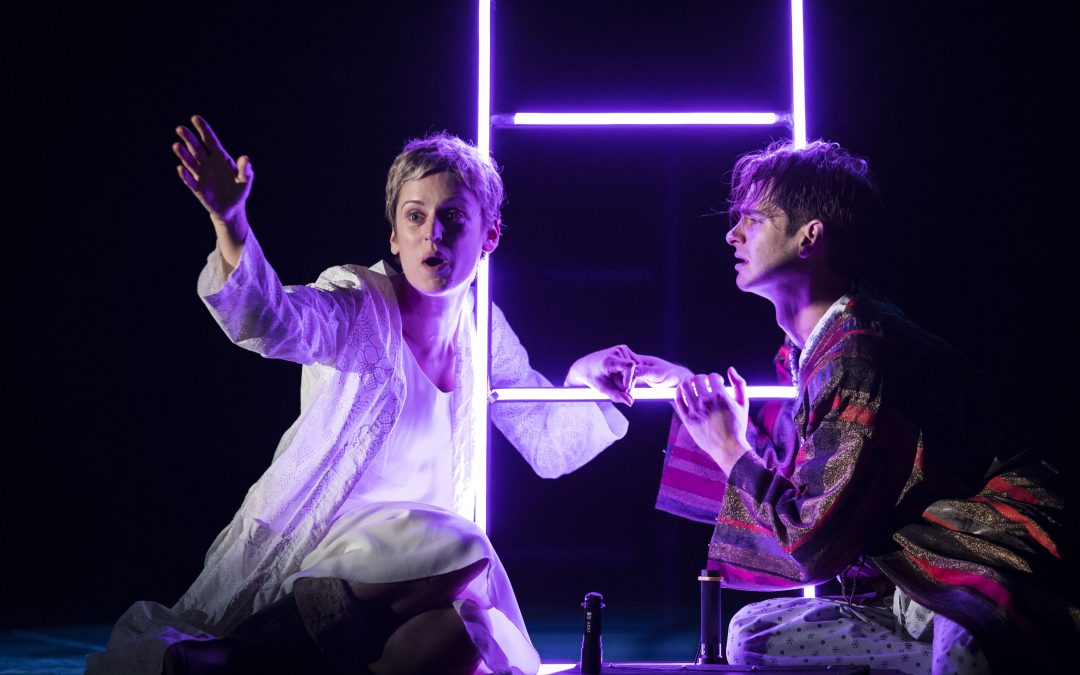
Tony Kushner’s epic two-part drama Angels in America was first seen at Britain’s National Theatre back in 1992. Now to celebrate its twenty-fifth anniversary, the plays have returned to the National, in a new production directed by Marianne Elliott and with lighting by Paule Constable (a duo whose previous collaborations have included War Horse and The Curious Incident of the Dog in the Night-Time), alongside scenic design by Ian MacNeil and costume design by Nicky Gillibrand, whose work together has included Billy Elliot.
From the earliest model showings Laurie Clayton, the lighting supervisor for the National’s Lyttelton Theatre where the show was to be performed, knew that it would present a number of challenges. In particular, there was a desire to include lighting in elements of scenery carried on the show’s three revolves plus separate rim revolve yet there was no depth in those revolves to incorporate slip rings to power that lighting. And there were many practicals that would either travel on stage as part of moving scenery or be carried on stage by the cast and set on the revolves or other areas of the set, which spread across every inch of the Lyttelton’s stage and beyond.
But Clayton already knew the solution to these challenges: RC4 wireless dimming. And not only did he know the solution, but he had quite a stock of RC4 products already available in-house to implement that solution.
“I think the first time we used RC4 products was on One Man, Two Guvnors back in 2011, when we bought one transmitter and six two-way dimmer modules. We used the same set-up on the tour, and they worked flawlessly,” he explains. “Since then we’ve added to our stock as we’ve needed to for productions such as Curious Incident and Great Britain, so we have a pretty good stock of RC4’s products in-house now. But the demands for Angels in America were so great that even with that stock, we had to do some shopping, adding a further ten dimmer modules of various types.” The additional units were quickly delivered by RC4’s UK distributor, Lamp & Pencil.
Angels in America’s RC4 kit list features 10 RC4Magic DMX4dim four-way dimmer modules, two RC4Magic DMX4dim-500 high-capacity dimmer modules, and 20 RC4Magic DMX2dim two-way dimmer modules. Some are mounted to scenery, some hidden in stand-alone furniture, and some concealed in individual practical light fittings: as well as a good stock of RC4 dimmer modules, the National also has a healthy stock of batteries and battery chargers to power everything. During the tech period, the National’s lighting team found good LED substitutes for the tungsten lamps originally fitted in some of these practicals, which presented no problems to the RC4 dimmers and dramatically extended the working life of the batteries. “Plus the RC4s great control of LEDs meant we had no problems at all when the TV cameras came in for the NT Live world-wide broadcast of the shows,” Laurie Clayton notes. He also comments particularly on the compact dimensions of the RC4 units, which lets them be hidden away in even the smallest of props or tightest of spaces: “no-one else makes anything as small.”
All of the receivers are fed by one RC4Magic DMXio transmitter, mounted behind the proscenium on one side of the stage. “The signal from that gets everywhere; we have had no problems at all with coverage, which is pretty impressive given that we’re using the full width and depth not just of the stage but of the scene docks behind and next to the stage!” However, the RC4 system’s unique ID ensures that there is no chance of interference with RC4 systems in use in the National’s other two auditoria.
While most of the RC4 units are used very traditionally, as wireless dimmers, one is used for a more complex effect: a telephone switchboard has a Raspberry Pi computer hidden inside to detect which buttons on it are pushed by the actor. This information is transmitted via WiFi to the sound control computer to trigger the relevant sound effect; the sound desk then triggers the ETC Gio lighting console via the OSC protocol, which then turns on the appropriate light in the switchboard via RC4 dimmers.
Though Angels in America is now approaching the end of its National Theatre run, the National’s RC4 stock will be kept busy with uses already lined up on the company’s next two productions. “They’re a great product,” Laurie Clayton notes, “tiny, versatile, reliable, do just what they promise, and with great support from the manufacturer and their distributor here on the odd occasion when something does go wrong or, more likely, when you need to make the dimmers do something no-one’s ever made them do before.”
Girlstar, which closed in mid-November at the Signature Theater of Arlington, Virginia is a modern fairy tale described as “The Voice meets Maleficent.” Anton Dudley wrote the book and lyrics, while the lighting design was provided by Jason Lyons. The production was one of the largest that has ever played the theater. A crucial part of the magic that made Girlstar a hit was possible because of RC4 Wireless of Raleigh, North Carolina.
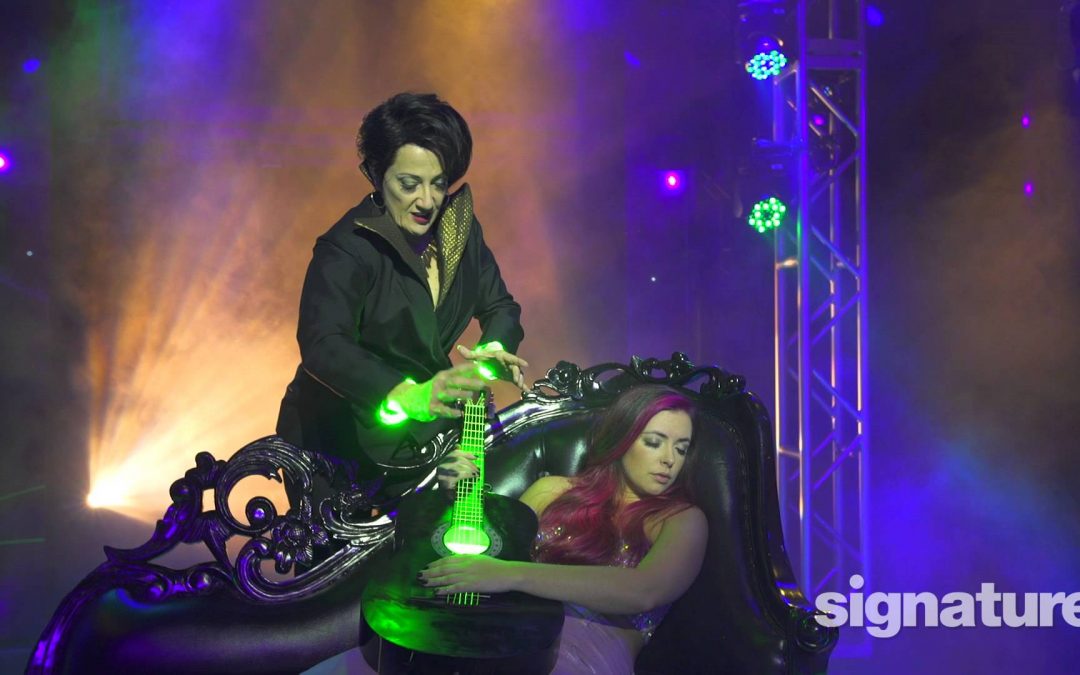
Creating the magic that was entwined throughout the production was a challenge. Lyons explains, “The craziest and most fun trick came from the sorceress- legendary record producer Daniella Espere (actress Donna Migliaccio). Her hands needed to glow green several times throughout the show as she was working her spells and then at the end of the play fade to red as her power starts to wane.”
The Signature’s head electrician, Sarah LaRue, was charged with creating that effect. LaRue asks, “How do you make hands light up? We went back and forth– is it going to be a prop, is it going to be a costume or is it electrics? What is it?”
At first, LaRue looked at LED gloves; they didn’t work at all. So she began the process of research, and found an unexpected solution: LED headlights for cars and motorcycles. “They come in a bunch of different diameters; we measured the actors hand to determine what size to get; we basically used this car headlight as a bracelet and sewed it inside her costume,” she explains. The solution was perfect, and was used in several of Migliaccio’s costumes. “For the final scene– we called it the nightmare scene–she had two colors in there, a green and a red. They turned green, then red and then they went back to green during her demonic transformation,” LaRue notes. The headlight was also used for Uncle Derek (actor Bobby Smith) “when his heart had to pulse red as the magic was taking hold,” explains Lyons.
Then there was the Jar of Souls– filled with Galaxy Goo and an LED headlight– that descended from the air. “We wanted to keep it as light and seemingly floating, so it flew in on the thinnest of aircraft cable. But we were able to get a battery and an RC4 unit into the base that allowed the Jar to glow from within,” notes Lyon.
The RC4 units that controlled the Jar of Souls and the headlights used for Migliaccio and Smith were DMX2dims. “The RC4 DMX2dim is very small, and it’s extremely reliable. We wanted it to light up every time it’s used, and it did,” LaRue states. The DMX2dim is a two channel, 16 amp dimmer that features RC4 OneTouch for quick and simple assignment of DMX channels and dimmer curves. RC4 Digital Persistence is also part of the DMX2dim, with basic options controlled via OneTouch. “RC4’s Digital Persistence makes those LED headlights respond like traditional halogen headlights, with very smooth dimming and a natural fade-out when turned off, explains James D. Smith, President and Chief Product Developer at RC4 Wireless.
The DMX2dim could also be found in a prop guitar. LaRue notes, “I drilled holes right below the bridge and ran six individual lengths of EL wire from inside the guitar and then up to the pins, stringing it like normal guitar strings. Inside the guitar there was a splitter and an inverter for the EL wire which connected to the DMX2dim pack.” There was also an automated Plexiglas stage that used RGBW tape which was controlled via two RC4 DMX2dim units.
LaRue has been a long time user of the RC4Magic DMX2dim. “The first time I needed some sort of wireless control was for Witches of Eastwick; we needed a fake fireplace to light up and come on stage. At the time, the other wireless dimmers on the market were really large and bulky, and I was looking for something smaller,” she says. LaRue has been using original RC4Magic DMX2dim wireless dimmers at the Signature since 2007; the theater has also purchased a handful of newer models, along with two new units on loan from Ford’s Theatre. Smith notes, “Our original RC4Magic dimmers, released in late 2006, provided simple, bare-bones, work-horse features. It was a rock-solid wireless dimmer with linear and inverse-square-law dimmer curves and 14-bit resolution at the power outputs. That resolution made LEDs look pretty good, but it would be a few years before high-frequency 16-bit resolution eliminated visible stepping almost entirely. The extended features and performance introduced in RC4Magic Series 3 — a PLASA London Award for Innovation winner in 2014 — are astonishing in comparison to where this journey began. It’s the equivalent of moving from a flip-phone to a smartphone.”
Lyons found RC4 a few years later on Saved at the Kansas City Repertory Theatre in 2010. He needed a pregnancy test to light up on cue each and every night. “We needed something bright enough to be seen, but small enough to be wirelessly controlled in the palm of her hand. With RC4’s equipment [specifically the Series 2 DMX4dim], we were able to create a rather incredible and effective moment with something so small and powerful, that allowed us to hit that perfect moment onstage every night to help tell the story. There was nothing else that could have done that- we were able to make something so small a powerful wireless controllable light. It kind of blew my mind because up to that point I did not think something like that was possible,” Lyons admits.
When asked if she’d recommend RC4 and their products, LaRue replies with a hearty, “Yes. First and foremost, the customer service is always phenomenal- I can ask them any questions, big or small, and they’ll always have an answer for me in a timely manner.”
Lyons has a very similar answer. “I know when I have an idea or an issue that I can call RC4 to get info and solutions that help me get my work done every day. Not all shows are the same and not every wireless moment is the same, and it’s so helpful to have such a range of gear to choose from to allow us to dream up new ideas and new ways of creating theatre magic. Sometimes having these kinds of moments on a show can be daunting or worrisome, but I’m always happy to have RC4 products on a show as the experiences I’ve had with them give me the confidence to know these will be solid and effective effects.”
Girlstar ended their run at the Signature Theater on the 15th of November 2015.
There are many variations of extreme sports, and they fascinate fans all over the globe. However, there’s another facet to this industry and that’s the individuals that actually film these athletes in some of the most inhospitable environments.
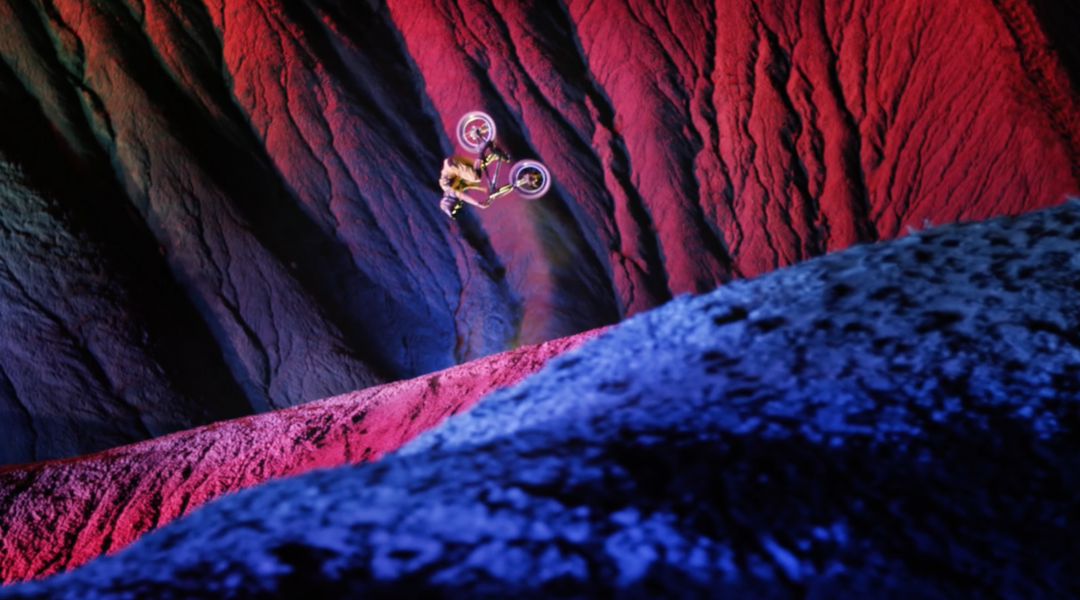
Such is the case for Darklight, a film by director Mike Brown and producer Zac Ramras of Sweetgrass Productions; in their quest to film professional mountain biking they traveled to the most remote Ewok forests of Oregon and the moonscapes of Utah. “These projects are just logistical nightmares; there’s always so much that can go wrong. And things will go wrong and you just have to be ready for them and make the best of every day. Consequently, you just can’t bring any light out there, you just can’t bring any equipment out there because it’s just not going to work,” explains Lighting Designer and Gaffer Mark Stuen.
To make sure their vision was captured correctly on film, Stuen chose the RC4Magic-900 wireless system to accompany them on their filmic quest. “The build quality, the stability and the reliability is unsurpassed; they are the best,” says Stuen.
The production took the team into the deserts of Utah and into the deepest forests of Oregon; typically they would off-road for about an hour to their chosen locations. “We were shooting in desert and we were shooting in the forest. During the day were well over 100 degrees, but we were shooting at night for most of it so it was a little better then, but still about 87 degrees. All of our gear had to be prepped and ready to work in this environment- the dirt in Oregon and the sand in Utah; there was always a risk of flash floods,” the lighting designer explains.
Once the production arrived at a location, they would call on a team of trail builders to create a series of ramps for jumps that were integrated into the natural landscape. Stuen says, “The night before, we would talk to the riders and find out how they’re feeling; each area had a different intensity to it, so if they were feeling a little tired, you didn’t want to have them doing massive jumps or doing backflips or things like that. Then, that next morning, the builders would go out for the day, and get that site ready. We would roll in about three hours before sunset and start moving gear into that location and roughing in where our lighting plan would be. Once it was dark, we could start turning pieces on. Then we would fine tune and shoot all night.”
The trail runs themselves were long, and that’s where RC4 came into the picture. “For this project, using RC4 was the only way to go. Anything less wasn’t going to operate over the distances that we were talking about. Inexpensive wireless starts to get funky around 100’, while the midrange stuff is good between 100’ to 600’,” notes Stuen.
For Darklight, Stuen chose the RC4Magic-900 as the backbone of the wireless rig. “We’d put the RC4Magic-900 DMXio Transceivers in the middle of a run– with just an onboard antenna, that gave us about 800’ to 1000’ in both directions. Then somewhere along that 800’ in both directions, we would put another little tower that had an RC4 RC4M-900 DMX4dim 4-Channel Wireless Dimmer. Then we would have lower grade transceivers, and those would go to the lights that were around them. RC4 had to be our backbone because of the distance,” the lighting designer states.
The RC4Magic-900 is one of the firm’s newer products in the RC4 product family. “RC4Magic wireless DMX and dimming systems have always provided every user and project with unique digital IDs that belong only to them. RC4Magic-900 builds on this with additional data security enhancements, including optional AES encryption. RC4Magic-900 dimmers provide super-smooth LED dimming, RC4 Digital Persistence to emulate the thermal decay of incandescent lamps, the RC4 Flkr Engine for fire, welding spark, and other effects, ColorMatch to optimize color rendering of LEDs, HSL for hue/saturation/level control, servo motor positioning, and much more,” explains James D. Smith, President and Chief Product Developer at RC4 Wireless.
The battery-operated RC4Magic-900 runs in the 902-928 MHz RF band with certification for use in Canada, USA, Australia, Brazil, and Singapore. Smith adds, “Just like 2.4GHz, 902-928MHz is an ISM band, which stands for Industrial/Scientific/Medical. ISM bands do not require end-users to obtain radio operator licenses. The internationally harmonized 2.4GHz and 5.8GHz bands get more and more crowded every year because corporate investment in new designs in those bands results in products that can be sold worldwide; designing a product that works only in limited markets isn’t popular in corporate boardrooms. But the FCC in the United States allows higher RF power at 900MHz than they allow at 2.4GHz, which increases range. Lower frequencies propagate better – they travel further and pass through objects for effectively. All of this combined is why RC4Magic-900 delivers about four times the range of RC4Magic Series 3 at 2.4GHz. And, by the very nature of how 900MHz works, we’re beating all the other 2.4GHz wireless DMX products, too.”
Superior signal propagation was critical for Sweetgrass. “Compared to the other wireless equipment we had on site, the RC4 equipment had no problem with line of sight. When we were in the trees in Oregon, it didn’t matter if we were line of sight or not. You could hike 1200 feet through the bushes and you’d still have signal with the RC4 equipment. With the inexpensive gear, you’d go around a couple trees and you’d have absolutely nothing at all,” he notes.
Another benefit of the RC4Magic-900 was the complete lack of stutter. Stuen says, “With other wireless systems, if you’re continuously changing a light, you’ll have stutter. After that initial connection, you’d hope that there was no more stutter, smooth fades and better transitions.” However that wasn’t the case with the other equipment on site and the stutter persisted, which brought on another issue. If we’re dealing with turning on and off lights as riders are flying around, that timing is very precise; we can’t have stutter for safety reasons. If we didn’t have a stable product, it physically could have put the riders at risk.”
Stutter also would cause problems with the physical aspects of filming. Stuen says, “We were shooting really slow motion and now all of a sudden, an 1/8 of a second or a ¼ second delay is the whole shot. It’s so much more pronounced.” These problems were eliminated by using RC4Magic-900 as the backbone of the wireless system.
Stuen and the team at Sweetgrass considered various different ways to utilize RC4 systems for Darklight. “We were going to run many multi universes of RC4 wireless for pixel control of the LEDs that we were going to put on the riders clothes,” the lighting designer explains. Technologically, the RC4 gear was a perfect fit for the concept. However, in practice, there were aesthetic issues involved. “It was interesting to look at but it wasn’t what we wanted. It was looking comical instead of wow.”
RC4 was the right choice for Darklight from the very beginning. Stuen confides, “RC4 has a very interactive and hands on support and tech department, which helped me even before I bought anything. They helped me troubleshoot and test some of my conditions and hypotheses. That’s obviously worth real production money and real money to me because it allows me to come informed when it’s time to actually purchase equipment to take out into the middle of nowhere. That kind of support system is very important for what I do.”
Darklight premiered online on Tuesday, October, 21 2015; Sweetgrass has more films in the works as well. Sean Dane, Sales Director and Application Specialist at RC4 Wireless concludes, “Our motto at RC4 Wireless is ’Live Life Untethered.’ The team at Sweetgrass Productions exemplifies what that means in all that they do. We’re thrilled to be part of it now and we look forward to the challenges they’ll bring next, as they push the boundaries of wireless lighting with their unique flavor of exhilarating and eye-catching films.
From the opening of George and Ira Gershwin’s timeless score for An American in Paris through to the final note, the RC4WirelessRC4Magic Series 3 wireless DMX and Dimming System plays a leading role in free-flowing seamless moves from one enchanting scene to another. With some of the world’s finest ballet dancers telling this classic tale, there simply is no place for power cables to run across any part of this stage.
Originally produced in Paris at the Théâtre du Châtelet, the show’s RC4Wireless gear was supplied by AVAB Transtechnik France. Production Electrician Michael Pitzer explains the extensive gear list in the show. “We are using a RC4Magic DMXio transceiver as the transmitter, four more DMXio receivers, ten RC4Magic DMX2dim 2-channel dimmers, four RC4Magic DMX4dim 4-channel dimmers, and eight RC4Magic DMX4dim-500 high-power 4-channel dimmers. They control a variety of sources, from single lamp sconces and cabaret table lights to multiple circuits of birdies on the Baurel Stage. In the Morris Columns and Shop Counters they are driving several circuits of incandescent lamps and sending DMX out to LED fixtures.” All 22 scenic and prop pieces are controlled using RC4Magic devices. The overall aesthetic of the show is markedly enhanced by this untethered approach, helping realize Natasha Katz, Bob Crowley and Christopher Wheeldon’s beautiful vision.
Having previously used RC4Magic systems in a number of productions, including Once and On The Town, Mr. Pitzer was confident that the show would arrive fit and ready for installation in the Palace Theatre in the heart of Times Square. Only the RC4Magic system supplies unique digital IDs to every customer and project. This means nobody has to go to the theatre next door or across the street, asking if they already use RC4Magic and try to determine what ID they are using. EveryRC4Magic customer and project is unique and will never interfere with any other, worldwide.
The RC4Magic Series 3 system has taken the world by storm since its release at PLASA London in 2014, where it received the PLASA Award for Innovation. That was followed by an Honorable Mention at the LDI New Product Awards.
About RC4 Wireless
Winner of the 2014 PLASA Award for Innovation, RC4 Wireless has specialized in low-voltage dimming for arts and entertainment since 1991. RC4 products are used in top venues around the world, including New York City’s Radio City Music Hall and London’s National Theatre, and supporting touring artists including Katy Perry and Taylor Swift. RC4 products are recognized for their reliability and their compact size, making them ideal for easy integration into props, costumes, and set pieces.
Palace Theatre opened in 1913 and became one of the world’s most famous vaudeville movie house—until its demise in the 1930s. In 1965 the Nederlanders purchased and renovated the theater, which became legitimate in 1966 with the opening of Sweet Charity.
After further renovations, the theater was transformed in 1994 as it housed Disney’s Beauty and the Beast and later Aida.
For fastest tech support response, please create a ticket. Multiple people -- real people! -- respond to support tickets to ensure responsiveness. Your satisfaction is very important to us.