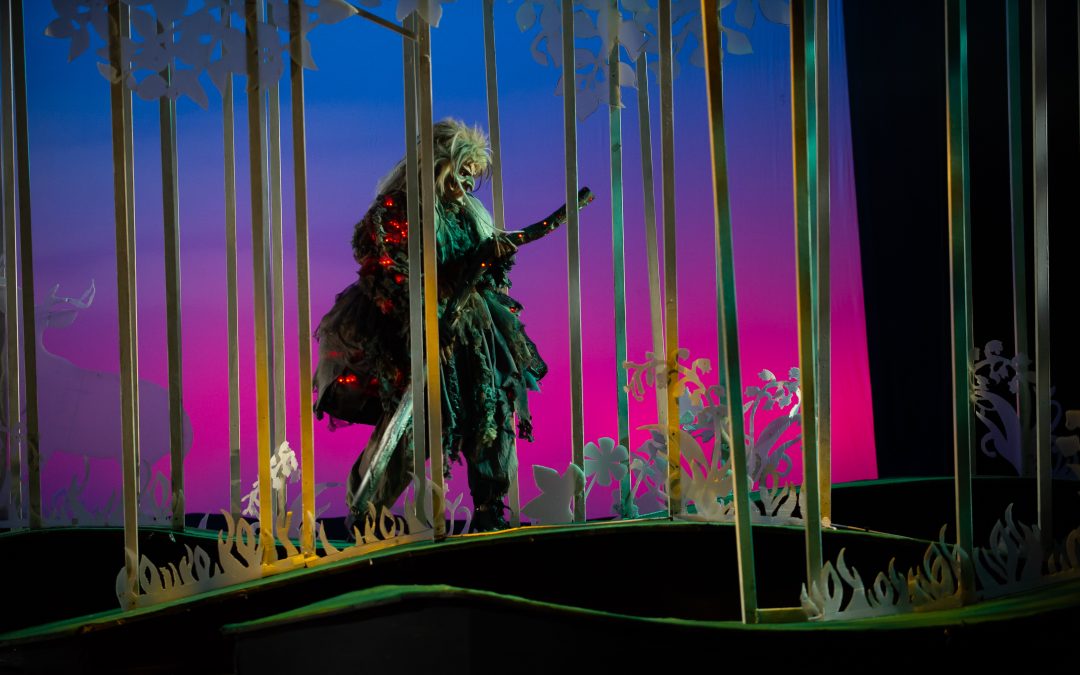
When you need an ugly witch to become magical, where do you turn? When he was working on the production of Into the Woods at the Utah Festival Opera & Musical Theatre, Lighting Designer, Chris Wood looked to RC4 Wireless products. For the production “We used 3 RC4 Wireless 2.4GHz DMXio Data Transceivers and 3 DMXpix units. Two DMX Pix units were used in the dress, and the third was in her staff so that we could continue the magic animation from her dress to the staff,“ explains Wood.
The dress was the creation of Costume Designer, Mallory Prucha. Wood explains: “Mallory sent me her rendering of the ugly witch dress and I immediately saw the image of magical energy building in the panniers, like fireflies, and then spiraling around her torso to her arms, and finally down to her hands.” The idea resonated with Prucha and Director, Valerie Rachelle. “Knowing the action of the LEDs in advance allowed for Valerie to incorporate the LEDs into her direction of the witch. Whenever the witch performed magic, had an emotional moment, or a decision to make, her dress would react appropriately,” said Wood.
The LEDs were cleverly concealed within the dress. Wood says: “Our Master Electrician, Matt Robson, and Craft Artisan, Sarah Beth Stewart, worked together on creating pouches hidden in the panniers for the equipment and batteries. Mallory came up with horsehair tubes that contained the pixel tape and wiring. These tubes allowed movement of the tape while the actress moved in the costume relieving stress on the tape and avoiding restrictions on her mobility.”
The RC4Magic DMXio and DMXpix were a perfect solution for Wood and Programmer, Omri Schwartz. “We had multiple versions of effects and pixel maps for the dress that we used depending on the witch’s mood. The great thing about using the DMXpix versus an Ardino unit is that we could, on the fly, make changes giving Omri maximum flexibility to make the changes I asked for,” notes Wood.
The DMXpix offered Wood a variety of benefits. “The size of the DMXpix made it easy to hide within the costume, not to mention how lightweight it is. We were able to utilize its ability to mirror output A and B, plus we were able to group pixels as a unit. This allowed us to reduce the number of addresses needed to control the panniers. It’s a powerful device,” says the Lighting Designer.
Wood has been working with RC4 Wireless products for a decade. “So many things can be made simpler by throwing a wireless dimmer on it – table lamps, chandeliers, fridges and so on. Initially, the price can be scary but over time, it balances out. The time saved with equipment that you know works and will continue to work makes up the difference. Some of the theaters that I design at don’t have the budgets to purchase but they do take advantage of RC4’s rentals,” he adds.
In the end, Wood has one favorite feature of the RC4 product line. “They are reliable; the only times that I have had a failure of a wireless lighting element was due to user error. Their customer support is also a huge plus,” he concludes.
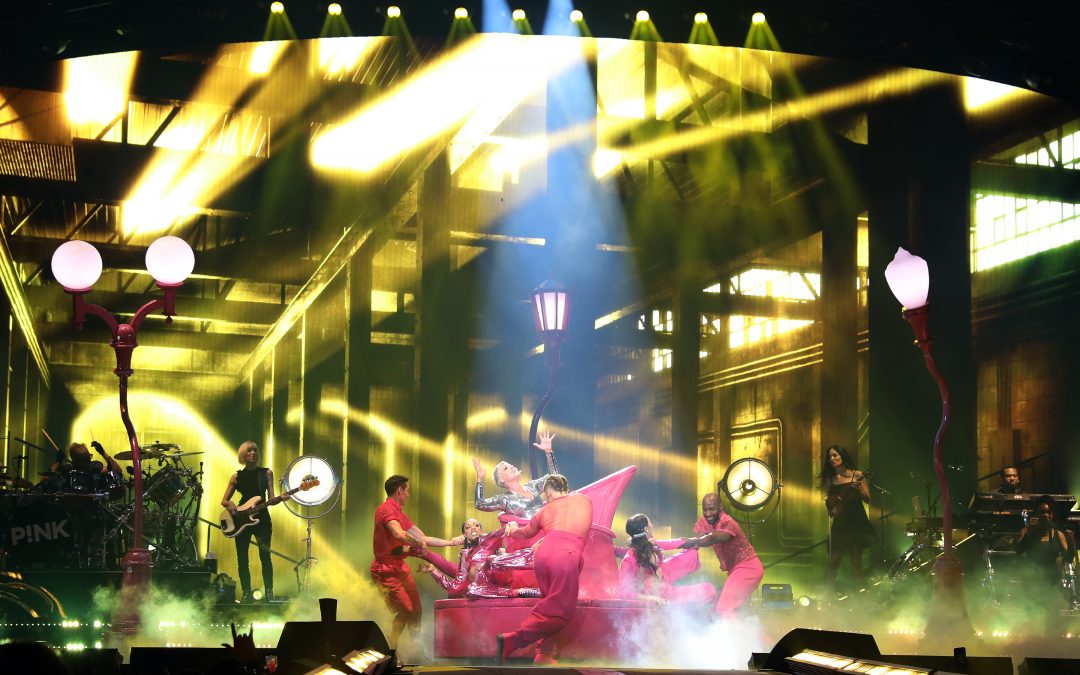
P!NK’s Beautiful Trauma tour is a visual extravaganza filled with meaningful music, numerous feats of athleticism and unique props. The team behind it, including Creative Director/Production Designer Baz Halpin of Silent House Productions along with Associate Lighting Designer/Programmer Eric Marchwinski of Early Bird Visual, relied on RC4 Wireless products to help create their vision for P!NK. “We required all of the vendors that were delivering props that included a wireless element to use RC4 products,” explains Marchwinski.
Wireless dimming that operates reliably throughout the world was a requirement for P!NK, since the tour travels from the US to the Pacific Rim. The P!NK production team is using the RC4Magic S3 2.4SX dimmers that are optimized for use in every nation. Marchwinski asserts: “We require a wireless system that is reliable, flexible, and easily expandable as we build the tour. RC4 products allow for multiple vendors to build props or set pieces, and upon arrival onsite, everything can communicate seamlessly. The RC4 products are built for theatrical and practical applications, and the product was built with so many of these needs in mind. The functionality and form factor, coupled with the wireless toolset/multi device management make RC4 unparalleled for any show environment with abundant wireless needs.”
Eight lamp posts that take the stage throughout this high flying circus-like extravaganza are controlled via RC4Magic S3 2.4SX DMX4dim-500’s; the units provide four channels of dimming, function from 6 volts DC all the way up to 35 volts DC and feature high resolution, 19 bit dimming. Eagle AVL and StageWorks collaborated to create the lamp posts that grace the stage. “For P!NK, Eagle AVL started developing the street lamp post LED effect with StageWorks, and made the RC4 Wireless recommendations,” explains Eagle AVL Lighting Department Director/Lighting Designer Felix Torres.
The production also uses RC4Magic S3 2.4SX DMXio-HG Data Transceivers with an external antenna to deliver a universe of data to the massive chandelier. This isn’t your grandmother’s chandelier; it’s the central acrobatic piece for P!NK’s aerial performance and flies through the air throughout the show. The DMXio-HG’s are used to control several hundred LEDs imbedded into the piece to ensure it shimmers for the duration of the performance. The DMXio-HG Transceivers–with the external antenna option–gives users top of the line security and reliability in the most challenging wireless environment, and does so in distances up to 300’ (91 meters). Marchwinski notes, “We have used RC4 Wireless products on many large shows before and our experiences have always been very successful. The support we receive from James [Smith, President and Chief Product Developer] and Sean [Dane, Applications Specialist] has been outstanding.”
Like Marchwinski, Torres is a longtime RC4 Wireless client. “I have used RC4 units for various theatrical shows in Puerto Rico in the past 3 to 5 years, as well as in multiple concerts and corporate events in the USA, and I can honestly say, that after many years working with wireless DMX, RC4 is by far the best, most stable and flawless product in the market,” Torres concludes. RC4 Wireless is also the only firm in the industry that offers a lifetime warranty for RC4 Magic products like those on tour with P!NK.
“When Silent House and Early Bird get together you know something spectacular is in the works. We love seeing what they come up with and playing a role in bringing their vision to life. No matter what the next project brings, we will be here, ready to meet the challenge,” reflects Dane.
P!NK, her Beautiful Trauma tour and the RC4 Wireless gear are currently down under in Australia.
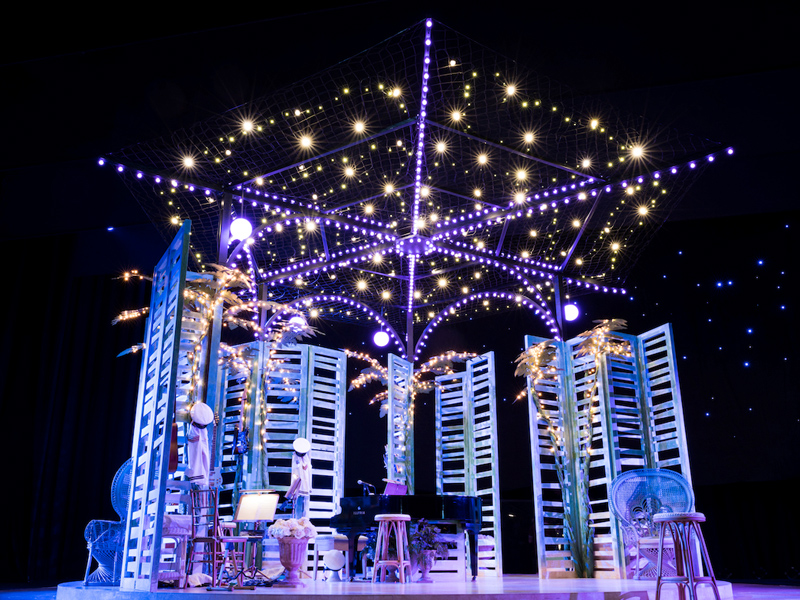
Shakespeare’s ‘Twelfth Night’ was first performed in 1602; since then, actors have been portraying Viola and Orsinio around the world. When Australia’s Queensland Theatre mounted their production of Shakespeare’s classic, they chose to use a revolve that required wireless DMX. “The stunning set design [by Tracy Grant Lord] was on an 11m revolve with a sea of set LX; the show also featured four musicians, three of which are on the revolve for the show. With that being the case, the Ethernet in our slip ring was dedicated to the sound team for the show to ensure that we could get signal back to the FOH console. As such, I knew that we needed a reliable wireless DMX system for lighting that could span multiple universes –three in our case– given the degree of control required,” explains Dan Maddison, Technical Coordinator at the theatre for the past 11 years.
There are several pieces on stage that required wireless control. “The majority of control was required for the Minleon RGB Digital String Lights; with RGB control over each lamp, the parameter count grew very quickly. The custom canopy from Lejin Christmas Lights contained a mix of LED Festoon and bud light controlled via a series of DMX Decoders with wireless data via RC4 products. There were also four hero lamps that we fitted out with RGBW SMD strip. These were controlled via constant voltage LED drivers with wireless data; with each shell being 250mm in diameter these deliver a beautiful effect,” says Maddison.
Wireless control was critical to the production. “We wouldn’t have been able to proceed without wireless connectivity, particularly with no more space available in the custom slip ring I had built. RC4 played an integral role in the show,” remarks Maddison.
For the Twelfth Night wireless system, Maddison turned to 6 RC4Magic 900SX DMXio Transceivers, 3 RC4M-900SX DMX4dim-500 High Power 4-Channel Wireless Dimmers and a RC4M-900SX DMX2dim 2-channel wireless dimmer. Maddison notes: “The DMX4dims 500s were used to control the musician LED sconce lights on the revolve; the DMX4dim-500s also provided smooth dimming for the Firefly LED bud light that was incorporated into the scenic foliage. The DMX2dim was used off the revolve to control the percussion sconce light.” Lighting Designer Ben Hughes also wanted individual control of the Minleon RGB Digital Festoon. Maddison explains, “We had to configure the controllers to be a DMX to Art-Net bridge to ensure we could plug and play with the RC4 receivers. This allowed 170 lights per universe -510 channels, with 3 channels per lamp. RC4 technology was used from start to finish.”
The RC4 900 series products were located throughout the revolve. “All LX data on the revolve were run via the three RC4 transceivers. There were two key locations where we were able to hide all of the LX control: The first was the day bed. This piece of furniture had quite a lot of space underneath for concealment of gear, and as such, it became the primary hub for LX requirements. The second was the faux grand piano center stage. The composition for the show called for a keyboard thankfully so we were able to use the space within the grand, since the sound board had been previously gutted).Other smaller control items were concealed within traps in the floor,” explains the Technical Director.
Maddison used RC4’s 900 Series of products, which is ideal for customers in the US, Canada, Brazil, Australia and New Zealand. “From the onset, we were very mindful of congestion in the 2.4GHz spectrum. As such, we made the decision–after consultation with Jim [James D. Smith, President and Chief Product Developer of RC4 Wireless] to add to our 900MHz infrastructure; with the ability to use our unique IDs with the associated Channel Mask we were set to go. Using the new RC4 Commander configuration software we were also able to check all of the configuration settings on all units to ensure they were set accordingly and running the same firmware,” Maddison says.
There were several other pieces that required wireless DMX. Maddison says: “We had a DMX iso splitter on one of the universes that was connected to the RC4 transceiver; we also had a Jands 4Pak D that we use to facilitate 2 channels of MR16s –3 lights per circuit. With the ability to address the 4Pak D, we could then control this from an external control device as you would with any slave device.”
Maddison has been depending on RC4 Wireless products “proudly since 2012. “ For people who are RC4 Wireless curious, Maddison advises, “Give RC4 a go. Their equipment is robust, reliable and has done everything we have ever thrown its way, which is a lot! In terms of service, Jim is only ever an email away in the event of any issues, and response times are always within 12hrs which is exceptional support given the time zone differences.”
When ‘The World of Snoopy’ took to the stage last summer at Theatre Aspen, the design team had a challenge: find a way to create wireless illuminated boxes and an LED doghouse that didn’t wash out on stage. “The original design concept all came from the idea of the Peanut squares; cartoons exist in these little squares that you read across, so the background was a series of squares that would light up. they just weren’t bright enough as far as we were concerned,” explains Lighting Designer Paul Black.
‘The World of Snoopy’ was comprised of 20 different vignettes that played out in two acts. “It introduced all of the regular Peanuts characters, and like the Peanuts strip, it had little sections that were lifted from the original cartoon. There wasn’t a plot line; the only consistent theme was Snoopy. There was Snoopy’s Red Baron moment, Snoopy’s writing moment, and then you’d cut to various things, like Sally at school, there were Charlie Brown and Lucy as a psychologist; it had all of those classic Peanuts moments,” says Black.
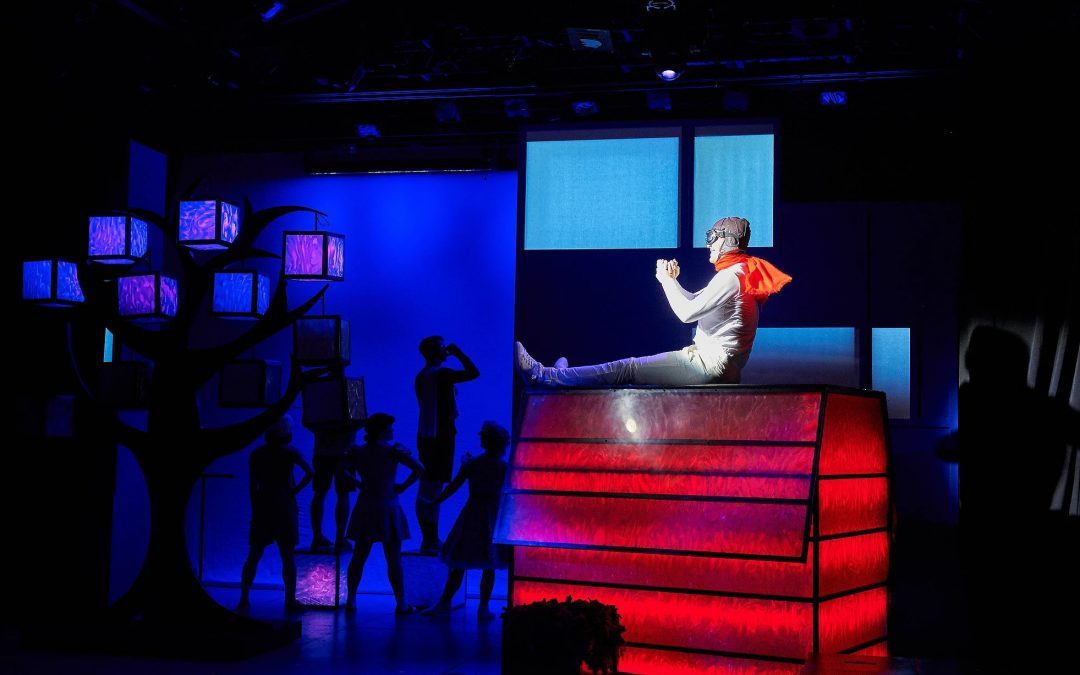
Each Peanuts character had a box and an assigned color; however, when a box left a character, it would change color. Black explains: “The characters started the show standing on top of their box; they’d get a special on their face and their spots; after that, all bets were off. For example, when Linus did his song about the Great Pumpkin, all of the boxes were piled around Linus, and we lit them orange, so they all looked like pumpkins.” In another scene, Woodstock t made a nest out of several boxes, and they turned yellow. “It was a two-hour show, so it was important that they could last two hours and be lit, but had also had to be bright enough, because it’s a cartoon. It couldn’t be dark and moody lighting, it had to be really bright,” Black adds.
The RC4 DMX4dim was key to making the boxes work. “When the set and props arrived at Theater Aspen – it originally started at Texas State – it was sort of dim. We rebuilt the LED cores and RC4 products were the dimming solution,” says Black.
Lighting Supervisor Colin Riebel used some technical magic to make the boxes stage ready. “The cores are something that I’ve seen done a lot with RC4 gear—you’re wrapping LED tape over a PVC center and putting the battery and the RC4 unit inside all of that. Colin was able to maximize that tape and the RC4 dimmer to get the blocks to actually be bright enough to see them,” Black adds.
There were six boxes that used during the show. “Each box had either a 10” or 12” PVC pipe that was wrapped with standard 12 volt RGB LED tape, and that went into the RC4 DMX4dim unit. Underneath that was an end cap for a drainage pipe; that’s what I secured the battery to; the DMX4dim sat on top of the battery with a power switch and a charging port. That whole assembly then got bolted to the bottom of the interior of the box, so the assembly would not move at all. So the performers were able to pick the boxes up, flip them upside down, put them where they needed them to, and the core stayed in the center,” explains Riebel.
The boxes were actually a magical part of the production. Riebel says: “While we’ve done stuff with LEDs before, there was a lot more magic in how they were used; it was a very tactile thing. Every time a performer moved or touched a box, it would change to a different color” Black adds, “This was a fun use of RC4 units because of all of the color changing and to use it in an interactive kind of way; the interplay of color helped tell the story, which then helped her tell the story of this new musical.”
There were a total of six RC4Magic Series 3 SX DMX4dims used for the boxes; however, the boxes weren’t the only pieces to use the RC4 equipment. “The doghouse was made out of the same Plexiglas as the boxes; it got pushed all over the place and it also had to light up. It only lit red, and it was really dim when it arrived,” notes Black.
Riebel explains what he did to make Snoopy’s doghouse pop: “The big problem was that it was red and needed to be bright enough to be seen with all the stage lights on and be on the entire time. We lined it with 15 meters of red LED tape, and then split up over four channels on one RC4 DMX4dim dimmer. I had two big motorcycle batteries inside the doghouse powering it all, so we were able to run it for the entire show. Inside Snoopy’s doghouse; we built a little wooden box that hid the two batteries, and the dimmer. It also had a power switch and a charge port. So it was a self-contained unit that was built for the interior of the doghouse.”
The budget was also a consideration for the projection. “When we started talking about this project, we knew about RC4 and we had the RC4 solution that I was able to say ‘Yes, definitely, we can do this. Let’s go down this road. We can make this happen,’ and that was really exciting. It’s always nice to say ‘yes, we can do this.’ If we had to do this using City Theatrical equipment, we couldn’t have done it because we couldn’t afford it; it also would have been too heavy and too big,” notes Black.
Both Black and Riebel are longtime RC4 users. “I love RC4 equipment. It’s one of my favorite things to work with, especially for these type of projects. I love working with LEDs, and the RC4 products are easy to use with them. I’m a huge fan and proponent of RC4,” says Riebel. Black adds, “We love RC4 units; we put it on lots of shows, we recommend them and tell our theaters to purchase them.”
‘The World of Snoopy,’ which is licensed by the estate of Charles Schultz, has been performed in three different theaters. “They want to send it out on tour; if they do, there will be even more RC4 Wireless gear on it,” Black concludes.
Katy Perry’s “Witness: The Tour” is more than just a concert production; it’s a kooky and creative journey that includes dancing eyeballs, giant insects, a massive inflatable hand and even a flight through space, courtesy of Saturn. It all reflects Perry’s personality, and it should, since Perry is directly involved in the design. “Katy’s productions are always amazing, and she invariably has something new and challenging to achieve. ‘Witness: The Tour’ is using our new RC4Magic Series 3 SX software, which makes LEDs in props and costumes even more pleasing to the eye, thanks to our exclusive 19-bit per color wireless dimming,” says James David Smith, President and Chief Developer at RC4 Wireless, headquartered in Raleigh, NC. RC4 has been working with Perry since her California Dreams Tour in 2011.
RC4 Wireless technology is there along for the ride with Perry as she works her way through her somewhat surreal, planet-hopping adventure. When Katy struts out on stage during “Déjà Vu” – surrounded by a massive stylized Venus flytrap– she’s wearing aaLED-infused beret, illuminated by Tom Talmon of Tom Talmon Studio, based in Los Angeles. “I’m fairly new to RC4 gear; back in the day, I used to tinker and try to find ways to do things with my electronics experience. I’ve always been resourceful and somehow figured it out,” states Talmon. But as technology advanced, Talmon saw the need to advance as well. “I was using equipment that was not necessarily cutting edge, but it was still better than what the consumer could buy. However, I wanted to be even better, and now, I can do much more with the RC4 Wireless units, especially in terms of pixel control,” he says.
For Perry’s beret, Talmon is using an RC4Magic S3 2.4SX DMX4dim, a 4-channel dimmer, paired with an RC4Magic S3 2.4SX DMXio transceiver, which can operate as either a transmitter or receiver. “Especially when illuminating costumes, the compact size of RC4 units is important, as is the fact that it seems to be bulletproof; it’s not cheap Chinese radio controlled garage door openers, which I’ve altered and used in the past. The units have good circuit protection, and it’s hard to mess things up,” he admits. All of the RC4 Wireless 2.4SX products operate in the 2.4GHz bandwidth, which is the recommended bandwidth for international tours.
The legendary RC4 Wireless reliability was also important to Talmon. “When you’re doing something live, you want it to work the way it’s supposed to work. The RC4 equipment has been extremely easy to work with; it finds the signal and works flawlessly. In the end, it’s nice to have a stable, reliable system out there,” Talmon notes
During “Hey, Hey, Hey,” the LED walls upstage slide open to reveal Perry astride a motion-controlled motorcycle. It has illuminated head and tail lights that are controlled via two RC4Magic S3 2.4SX DMXio transceivers. The motorcycle was fabricated by Santa Fe Springs-based DAS Design Works, who has a longstanding relationship with the RC4 Wireless team. “They are absolutely the only wireless DMX that we’ll work with, and it’s not just due to their products. Their service is amazing; between the product and their customer service, we have no reason to call anyone else,” states Aaron Ford, a partner at DAS Design Works.
During one of her flights, Perry is in a stylized star wirelessly controlled by a dozen RC4 Wireless RC4Magic S3 2.4SX DMXio transceivers; the star was fabricated by Santa Fe Springs, CA-based ShowFX. An RC4Magic S3 2.4SX DMXio-HG transceiver and an RC4 S3 2.4SX DMX4dim can be found on the massive inflatable lion head created by Burnsville, MN-based Landmark Creations that dominates the epic song “Roar.” “The RC4 equipment has been working flawlessly; technically, there have been no issues at all,” notes Thomas Walls, the lighting crew chief for The Witness Tour.
There are a handful of people on the tour who operate various aspects of the wireless system including carpenters and wardrobe; not all of them have experience with wireless dimming. “The learning curve with the RC4 equipment was pretty seamless and it all made sense to us,” says Walls. Ease of use is one of the hallmarks of the RC4 Wireless system, where all of the products work in a similar manner; the firm calls it “Harmonized Design”. “The beauty of the RC4 Harmonized Design is that new concepts, techniques, and methods introduced for one product or project can seamlessly transfer to all our other products. Thus, overcoming the 16-bit barrier and delivering 19-bit per color LED dimming in our DMX4dim results in higher resolution dimming in our LumenDim and W-DIM lines as well. The same is true when new dimmer curves and other features are added. Everything advances together, is debugged and tested together, and is released together,” states Smith.
One of the unique features of RC4 Wireless products is the System ID; this gives each user a super secure, private ID that is used only for their particular wireless DMX universe and the RC4 devices associated with it. “The crew really likes the unique System IDs and were able to understand how to set the system up without any problems,” Walls adds. While other firms have user IDs, RC4 Wireless is the only firm that provides each user a private, secure ID that is used exclusively for that individual.
Katy Perry, her props, her beret, and RC4 are touring the world through August of 2018.
For fastest tech support response, please create a ticket. Multiple people -- real people! -- respond to support tickets to ensure responsiveness. Your satisfaction is very important to us.