
Products
Reliable, feature-filled wireless DMX and dimming for lighting, props, costumes, and scenery.
DMX Cable Elimination and Wireless Data Distribution
A pair of RC4Magic Series 2 DMXio units replaces a DMX data cable in lighting control applications. They work reliably to 200 feet (65m) or more inside theatres and other performance spaces. A DMXioR3 (the most current version, shipping now) is configured as a transmitter or receiver with the press of a button.
Any number of DMXio receivers can be used. Thus, a multi-unit RC4Magic Series 2 system can take the place of splitters, isolators, and distribution boxes, providing superior electrical isolation while eliminating unsightly wiring.
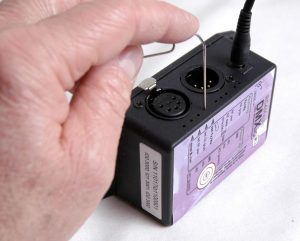
TX/RX mode and other settings are selected using tamper-resistant recessed buttons. This ensures your configuration will not accidentally change after you have installed the unit.
As a receiver, the DMXio decodes the rf signal from the transmitter, rebuilds the DMX universe, and regenerates a standard DMX signal with the same number of channels and the same packet rate as the data going into the transmitter. DMX in and out are compliant with USITT DMX512/1990.
As a transmitter, the DMXio decodes the incoming DMX universe, encodes and encrypts it, and broadcasts it using Direct Sequence Spread Spectrum (DSSS) digital radio. Unlike wired DMX, the broadcast signal includes error checking and correction codes, and is not affected by minor interruptions and interference. DMX channels that are changing are allocated more bandwidth than channels that are not changing, but all channels are broadcast with appropriate speed, redundancy and accuracy.
Power can come from the supplied wall transformer, from external batteries, or (optionally via internal jumpers) from XLR pins 4 and 5. A small pack of 6 AA batteries can be used for portable operation with, for example, a DMXter, Pocket Console, or other battery powered DMX signal source.
In many cases, the DMXio can be connected right at your lighting console or other controller, before your DMX signal continues to other devices in your system. The distance from console to stage is rarely more than 100 feet, well within the 200 foot range of RC4Magic.
Line-of-sight is not required for RC4Magic, but dense objects between units – like concrete walls – will attenuate the radio signal and reduce the available range.
Sometimes — though rarely — you may wish to use an external antenna. For those cases, we have the DMXio-HG, which is identical in every other way to the DMXio.
DMXioR3 Specifications
- Dimensions: 3.4” x 2.3” x 1.55” nominal (approx. 86mm x 59mm x 40mm)
- Mounting flanges extend an additional 0.5″ (13mm), for a bottom footprint of 4.4″ x 2.3″ (112mm x 59mm)
- 5-pin male and female XLRs for DMX in and out, hardwired together
- Power Input: 8VDC – 16VDC, 300mA
- Standard 2.1mm power receptacle, center positive
- Internal jumper option to take power from XLR pins 4 and 5
Transmitter Mode
- Only 1 DMXio transmitter should be operated on each system ID.
- DMX Input: meets USITT DMX512/1990(4us) with 1-second data hold after dropout
- NO INTERNAL DMX TERMINATION
- DMX Output: straight-thru hardware connection from DMX input to output
Receiver Mode
- Any number of DMXio receivers may be used in a system.
- DMX Output: meets USITT DMX512/1990
- The DMX specification allows up to 32 devices on a DMX output. The DMXio data output exceeds this requirement and is capable of driving additional devices.
- Internally protected against static discharge and excessive line loading.
RC4Magic DMX Protocol Compliance
- DMX inputs and outputs comply with USITT DMX512/1990(4us).
- Packets with non-zero start codes are not transmitted; RC4Magic cannot transfer proprietary data or RDM packets.
- DMXio receiver output closely mimics DMXio transmitter input, providing the same number of DMX channels and the same number of packets per second (pps).
- Minimum number of DMX channels per packet: 1
- Maximum number of DMX channels per packet: 512
- Minimum packet-per-second rate: 12pps (slow rates used only when incoming dmx is slow)
- Maximum packet-per-second rate: 44pps with 512 channels, 10000pps with 1 channel